

Don't Die Wondering
On I Saw the TV Glow (2024)

All of my reviews contain spoilers. Content warning for discussion of suicide.
My favorite virtual reality video game is a game called Superhot VR, a first-person shooter where the twist is that time only moves when you move. Your opponents are red glass-like figures that shoot and punch and throw ninja stars at you, and they shatter into pieces when you get in a hit back at them. They come at you in waves, and shoot at you with precision, but because the bullets only move towards you when you yourself move, the game makes you feel like the hero of a high octane thriller—successfully dodging out of the way of hundreds of bullets while taking down dozens of enemies, and all, at least the way I play it, in slow motion.
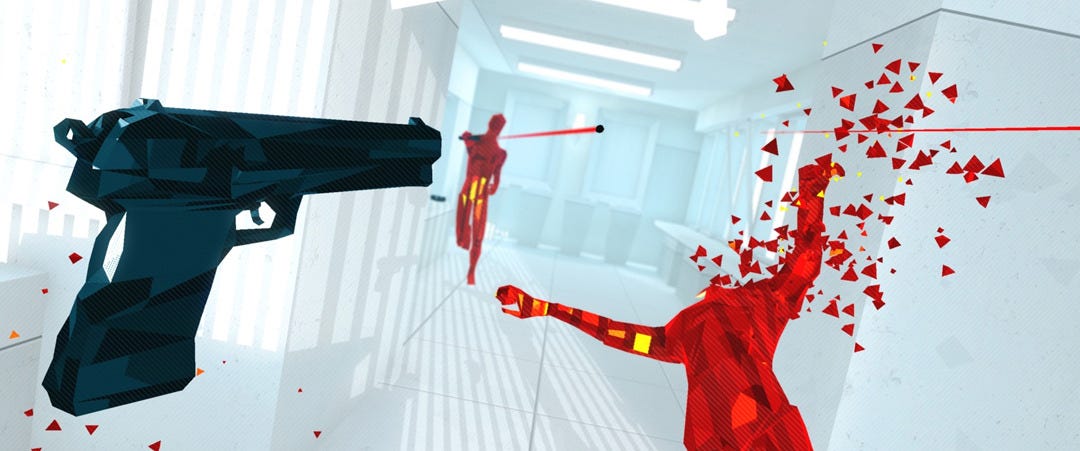
The game has a meta narrative in addition to its basic gameplay. After slipping on your VR headset and loading up the game, you find yourself in a dark and dusty office surrounded by computers and floppy disks to insert. This is “reality” as the game presents it. After inserting a floppy disk, you are prompted to put on a virtual VR headset.
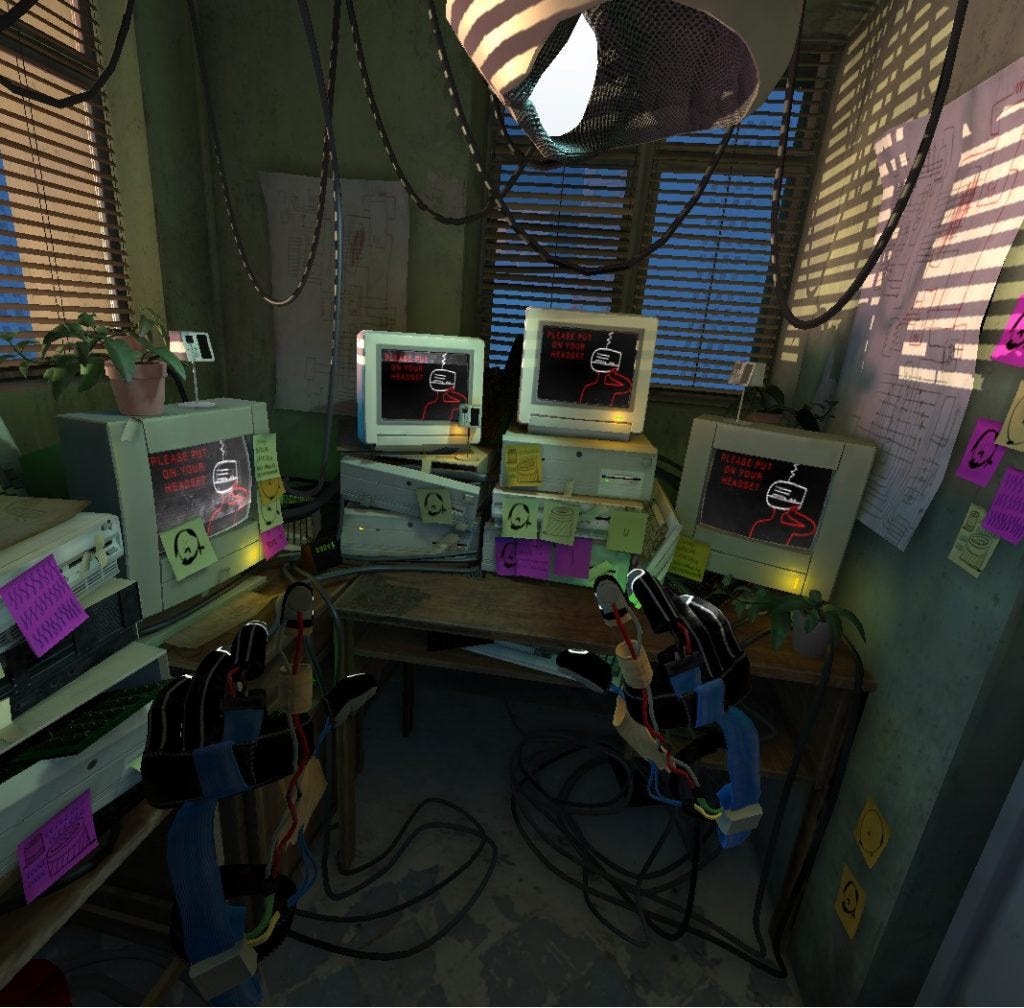
Only then do you enter “the game,” which operates as a kind of virus on your mind throughout play. The trajectory of play—killing the red glass figures—is occasionally broken up by the computer prompting you in a way that feels as if you are being trained or controlled for some other purpose. The prompt is generally to commit suicide within the game world: once about halfway through, you have to jump off of a rooftop—one of the scarier and more realistic experiences you can have in VR. This meta narrative creeps in more and more throughout play, training you to understand that you “win,” not by successfully defeating enemies, but by doing what the computer tells you to do. When you beat the final level, you are transported back to this dusty office, back into the realm of “reality.” Someone knocks at the office door. You open it to be presented with a gun. “Collect your reward,” the computer told me. So I shot myself in the head.
Playing this game was a transcendent experience for me. It’s the only VR game that’s successfully gotten me fully immersed, in both the primary game play and in the meta narrative, and I found it to be an incredible and embodied game, one that doesn’t just present a story about a computer mind-virus. It gives one to you.
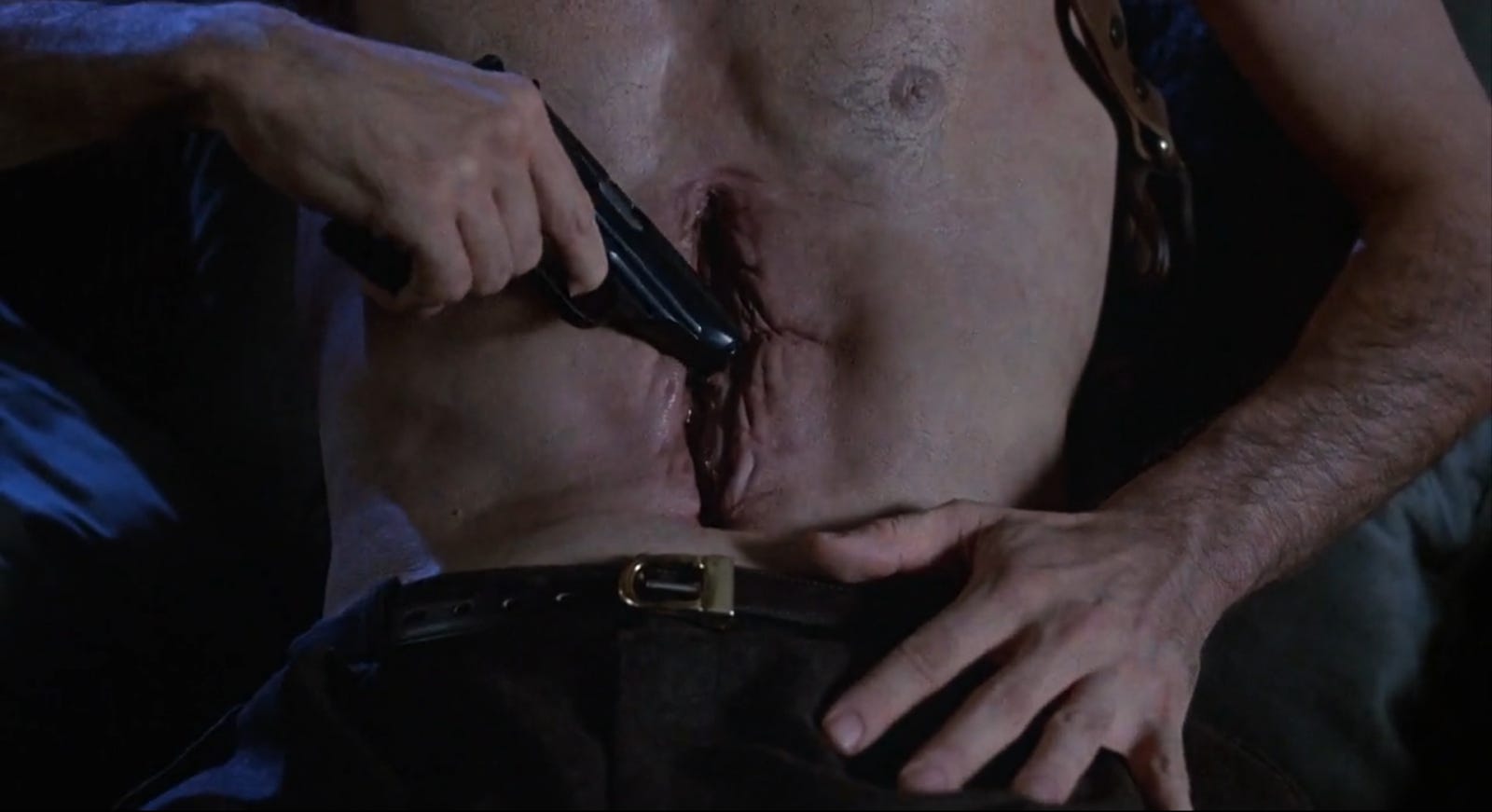
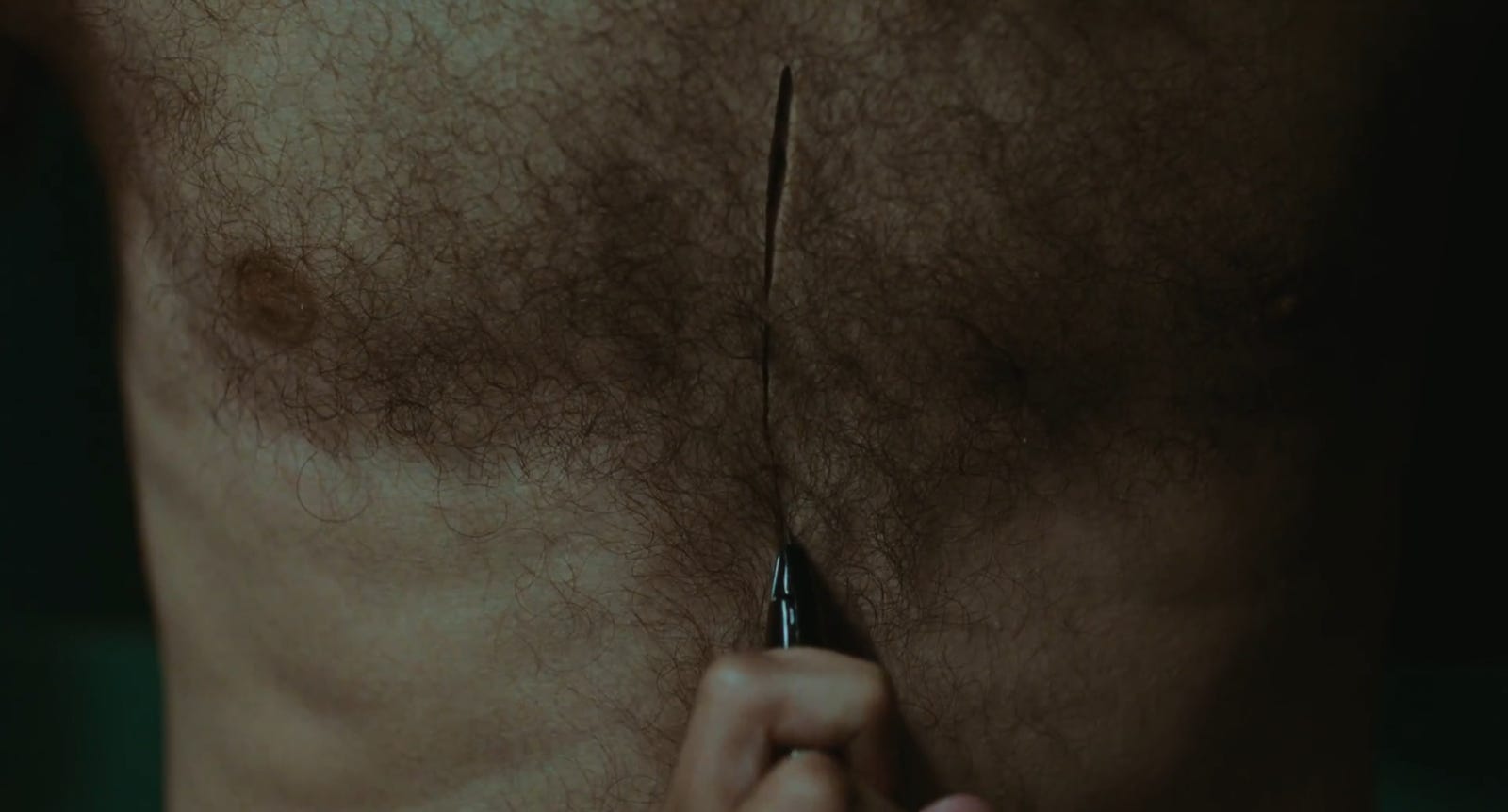
I was reminded of this experience when watching Videodrome, David Cronenberg’s 1983 film about Max, the president of a small television station who comes across a broadcast of pornographic snuff films that disturb and enthrall him. As Max watches more of these films, he begins to hallucinate and the boundary both between the real world and the world of these films, and his body and the body of his television begin to slip. Videodrome, like most of Cronenberg’s films, is grotesque in its depiction of body horror: a television screen opens an orifice for Max to put his head inside, a slit opens up in Max’s stomach where he stashes a gun.
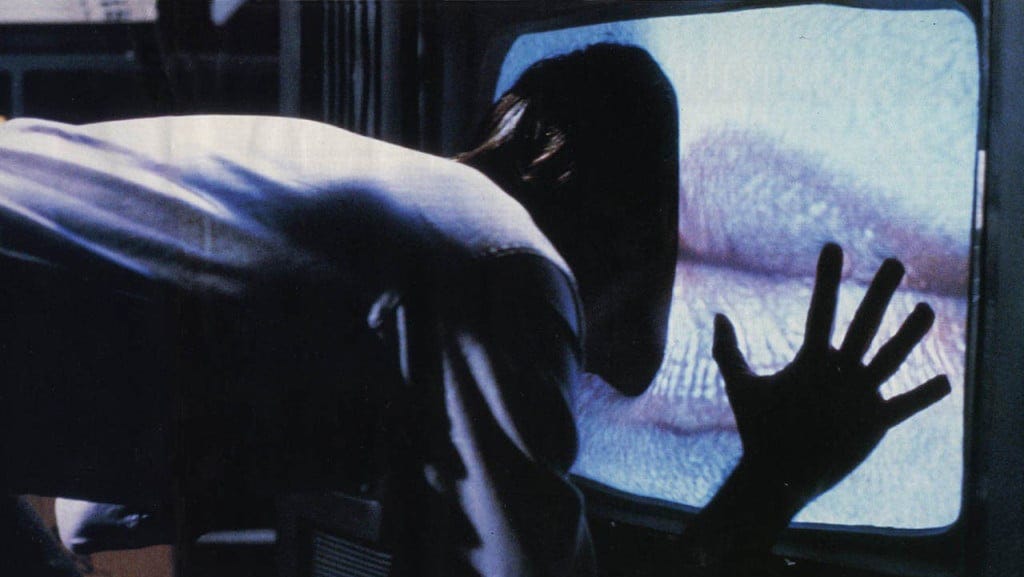
Max soon learns that the films are infecting him with some kind of mind-virus that are causing these hallucinations, but this doesn’t slow down his progress into madness or his obsession with what he’s seeing on the TV. He struggles to identify the difference between what he is seeing in life vs on the screen vs only in his mind. This climaxes in a sequence wherein he hallucinates entering the world of the snuff films—a red room where women are beaten and murdered—and he whips, not a woman, but a television set depicting a woman. Videodrome is obsessed with not only the world of television as its broadcasts capture our attention, but the alluring nature of television in and of itself as a physical object.
Videodrome then ends with Max capitulating to the mind-virus. He sees himself on a television screen committing suicide with the gun that has been living in his stomach opening. “Death is not the end…your body has already done a lot of changing, but that’s only the beginning. The beginning of the new flesh. You have to go all the way now. Total transformation. Do you think you’re ready?” the television asks him. The TV screen breaks open at the moment that Max’s filmed self pulls the trigger, and out bursts a mass of blood and guts. So Max, in real life, does what is only obvious: he takes the gun out from his stomach cavity and holds it up to his head. “Long live the new flesh,” he says. He shoots himself in the head.
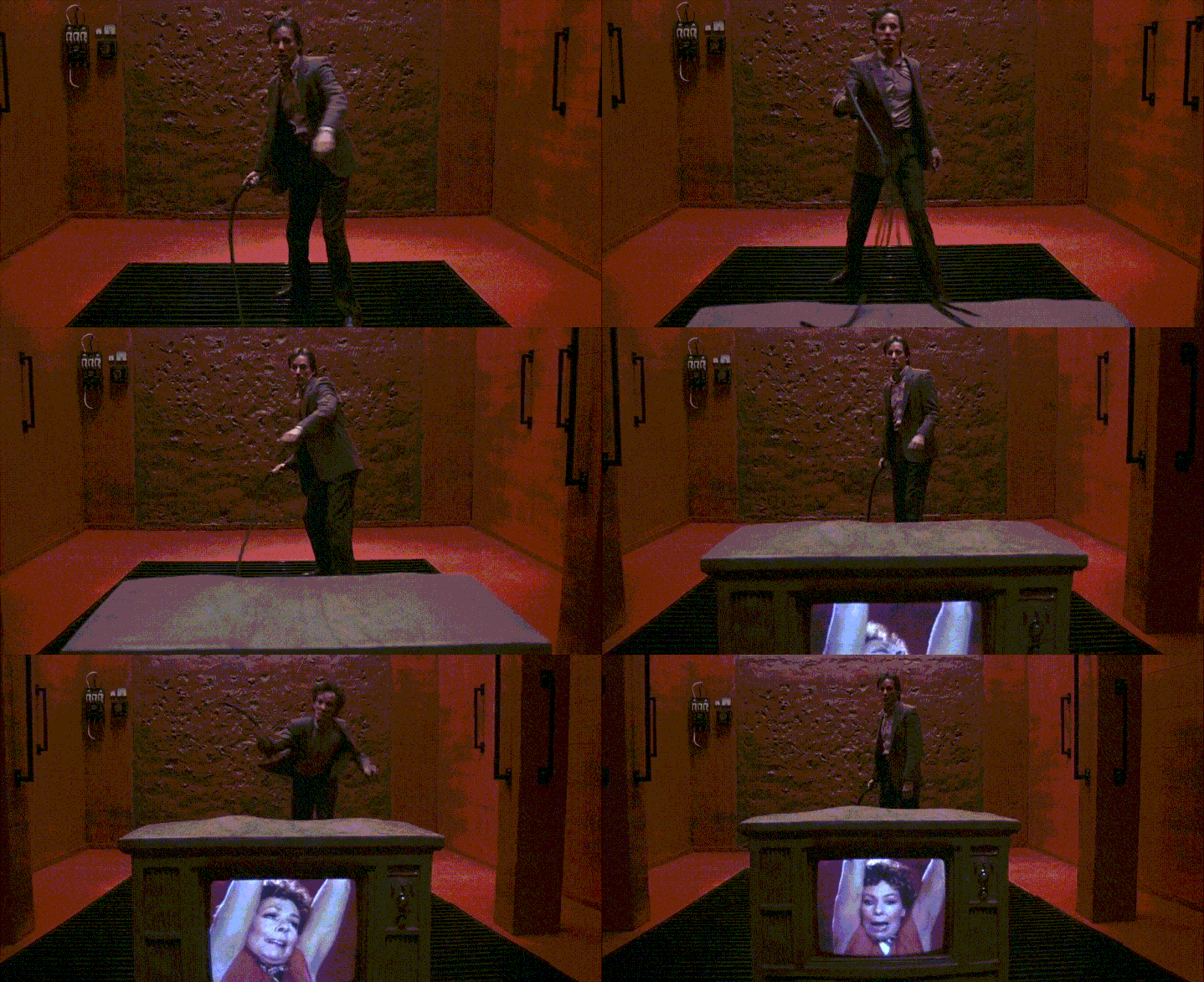
The ending of Superhot VR was ultimately changed. In 2021, the developers decided to remove all elements of the game that simulated suicide. The team announced, “considering [the] sensitive time we’re living in, we can do better than that. You deserve better. All scenes alluding to self-harm are now completely removed from the game. These scenes have no place in Superhot VR. We regret it took us so long.” I found this incredibly disappointing.
I still, even now at 30, consider and call myself a “computer kid.” I love to go on the computer. I don’t own a TV, so all visual media is subsumed into this one magical device that sucks endless numbers of hours from my days. And I think inherent with being a computer kid—not an iPad baby, to be a computer kid you need to know how to use Windows at the very least—is having a kind of ambivalence about computers. Of course I love computers. Of course I have a computer mind-virus that keeps me zombified in front of a screen and away from the many other things in life that bring a more peaceful kind of joy. So naturally, I love art that engages with this sense of ambivalence. How much control do you really let this beautiful glowing screen have over your life?
In I Saw the TV Glow, Jane Schoenbrun’s second feature length film from 2024, Owen (Justice Smith) and Maddy (Jack Haven) are also obsessed with a little glowing box. They bond soon after they meet over a TV show, The Pink Opaque, that airs from 10:30 to 11PM on Saturdays. Owen is younger than Maddy and his parents won’t let him stay up past his bedtime to watch it, and anyway, “isn’t that a show for girls?” Owen’s dad asks him. So Maddy invites him over to her house to watch it, and Owen takes her up on it, lying to his parents about a sleepover at a classmate’s to get away with it.
The Pink Opaque is a supernatural horror teen drama about Isabel (Helena Howard) and Tara (Lindsey Jordan) who communicate via a psychic connection, represented by the outline of a pink ghost on the back of their necks that glow when they connect. They’ve only met in person once, at summer camp, but every week they use this psychic connection to help each other fight monsters and defeat the ultimate big bad: Mr. Melancholy, “the man in the moon.” The Pink Opaque takes heavy inspiration from Buffy the Vampire Slayer in its monster-of-the-week structure, cheesy aesthetics and practical effects, and its melding of supernatural threats with the drama of adolescent friendships. Maddy and Owen are both obsessed, and Maddy records the episodes and leaves the VHS tapes for him in the high school’s dark room.
Two years later, Owen finally returns to Maddy’s house, to watch an episode of The Pink Opaque together, in person. She tells him that she’s planning to get out of this town, that if she doesn’t leave, she’ll die, and Owen tells her that if she leaves, he won’t have anyone to watch The Pink Opaque with. She takes a pink marker and draws a ghost on the back of his neck. A few weeks later, Maddie disappears. That same month, at the end of Season 5, The Pink Opaque was canceled.
Eight years pass before Owen sees Maddy again. His life is one of monotony. He lives at home with dad. He works at the movie theater. One night, while driving home, his route is blocked by a downed power line surrounded by burnt and torn pages from a TV guide book. He exits his car and picks up a page and finds an episode description of Season 6 Episode 1 of The Pink Opaque, “Escape from the Midnight Realm.” Days later, he runs into Maddy at the grocery store. “Where have you been all these years?” Owen asks her.
But Maddy is evasive and confusing in her response. “When you think back on watching The Pink Opaque, how do you remember it? Do you remember it as just a TV show?” She asks him, “Do you ever have a hard time distinguishing what happened in the show and what happened in real life?” Owen is frustrated and disturbed by these questions, and doesn’t understand why she keeps talking to him about The Pink Opaque when he just wants to know where she disappeared to. But that’s what she’s been trying to tell him, that that’s where she’s been all these years. Inside the show. Inside The Pink Opaque.
Like Videodrome, I Saw the TV Glow is fascinated by the way TV can bleed into real life. How it enters our fantasies and dreams and presents a world that can feel more real than real life. But what Maddy tells Owen is beyond what he can really comprehend: it’s not that The Pink Opaque feels more real than real life, it is real life. And this life, this life that feels monotonous and meaningless, is what is pretend.
Owen is an adult now, and so Maddy’s ramblings sound like a concerning form of psychosis to him, but when he gets home, he watches his tape of the final episode of The Pink Opaque anyway. In it, Isabel and Tara are faced with the encroaching threat of Mr. Melancholy, and decide that the only way they can defeat him is if they meet up in person. But before Isabel is able to reach Tara, Tara is intercepted by Mr. Melancholy’s goons and they bury her alive. Isabel is caught soon after. They cut out her heart and put it in a freezer, and then they feed her the Luna Juice, a potion that will send her to the Midnight Realm, a place of monotonous nightmares. “Soon you won’t remember anything,” Mr. Melancholy says, leaning over her, “Your real name. Your superpowers. Your heart. You won’t even remember that you’re dying.” Then they dig a grave and bury Isabel too. And then the episode ends. That’s the end of The Pink Opaque.
The film does some beautiful and powerful cinematographic work during this scene, where for a moment, the aspect ratio and graininess of The Pink Opaque and the film switch: now Owen and his life are nothing more than a TV show, while it’s The Pink Opaque that’s the real world.
I Saw the TV Glow is a divisive film. On Reddit, posts about the film range from “y’all need to watch ‘i saw the tv glow’ holy fuck” to “I Saw the TV Glow | what the heck was it about?” to “People pretend to like ‘I saw the TV glow’ just to feel ‘in’, right?” Naysayers complain that the film is boring or slow, that the message is confusing, that the message is too heavy-handed, that it isn’t about anything at all and is just communicating a vibe. I’ll admit that I didn’t love the film the first time I watched it in theaters in May 2024. I thought it was interesting, but I found it pretty slow, and it didn’t quite click with me right away. But I haven’t been able to stop thinking about it since. Some films just have to sit inside of you for a little while.
After he rewatches the final episode, Owen returns to Maddy to hear the rest of her story. She tells him that after she ran away, she spent a few years working dead end jobs, feeling cut off from her life, like the years were just slipping away from her, but that a little after her 22nd birthday, she realized what she needed to do. She paid someone to bury her alive. She dug a hole. She bought a coffin. She got inside and closed the lid. “I told myself: this is crazy. What you’re doing is crazy. But another part of me knew that it wasn’t. That it was survival,” she says. She spends days in that coffin, starving and suffocating until finally, she dies. “I felt myself... start to leave myself. It was like I was watching myself on a TV all the way across the room… And then I was clawing my way up out of the ground. And then I was at the surface, gasping for air, rain pouring down on me. Thunder and lightning. And I was finally back there... Back at sleepaway camp.” She was never Maddy at all, she tells Owen, she was Tara all along. And he is Isabel. And they’re needed back in The Pink Opaque. Back in their real lives. And all Owen needs to do to get there is bury himself alive.
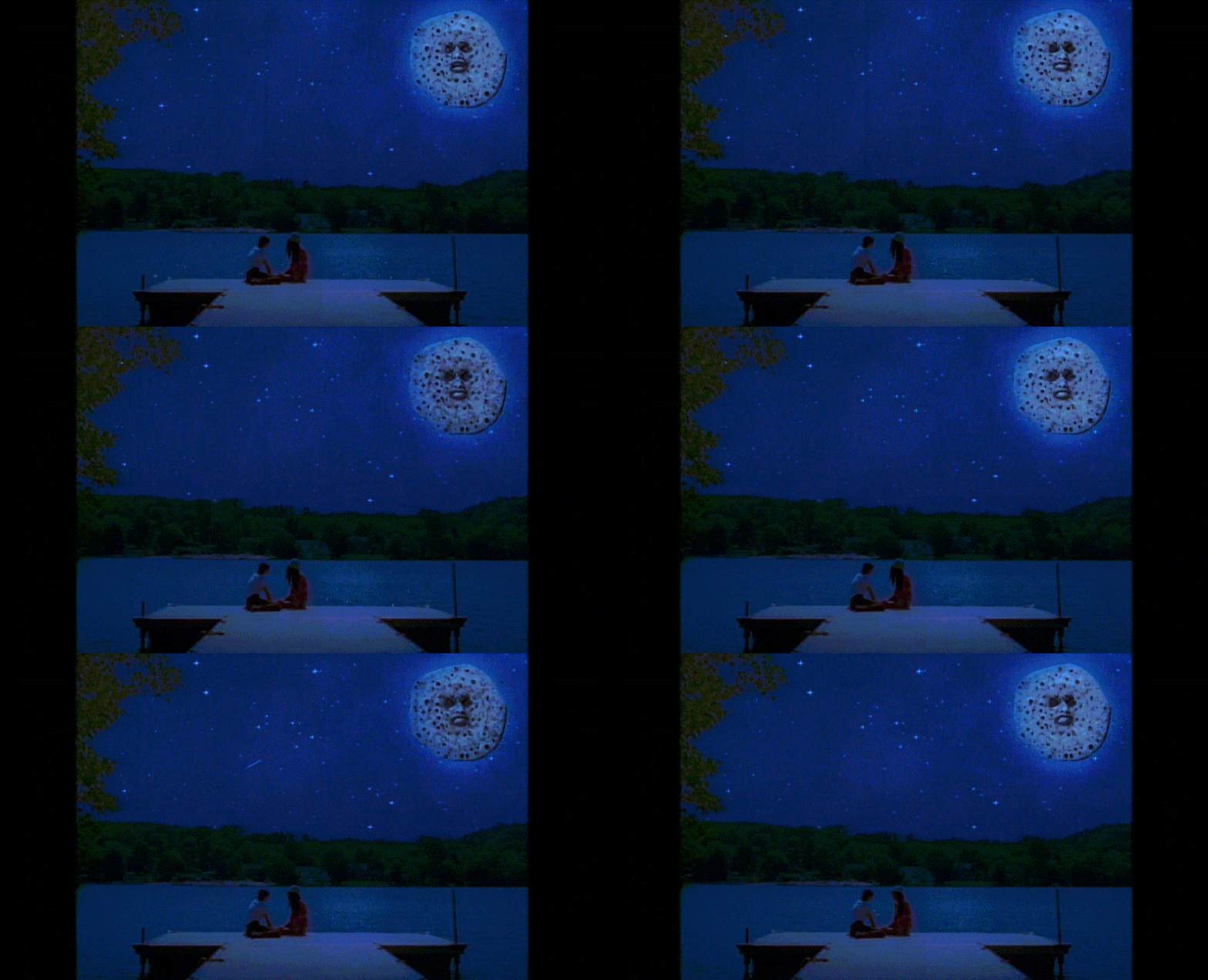
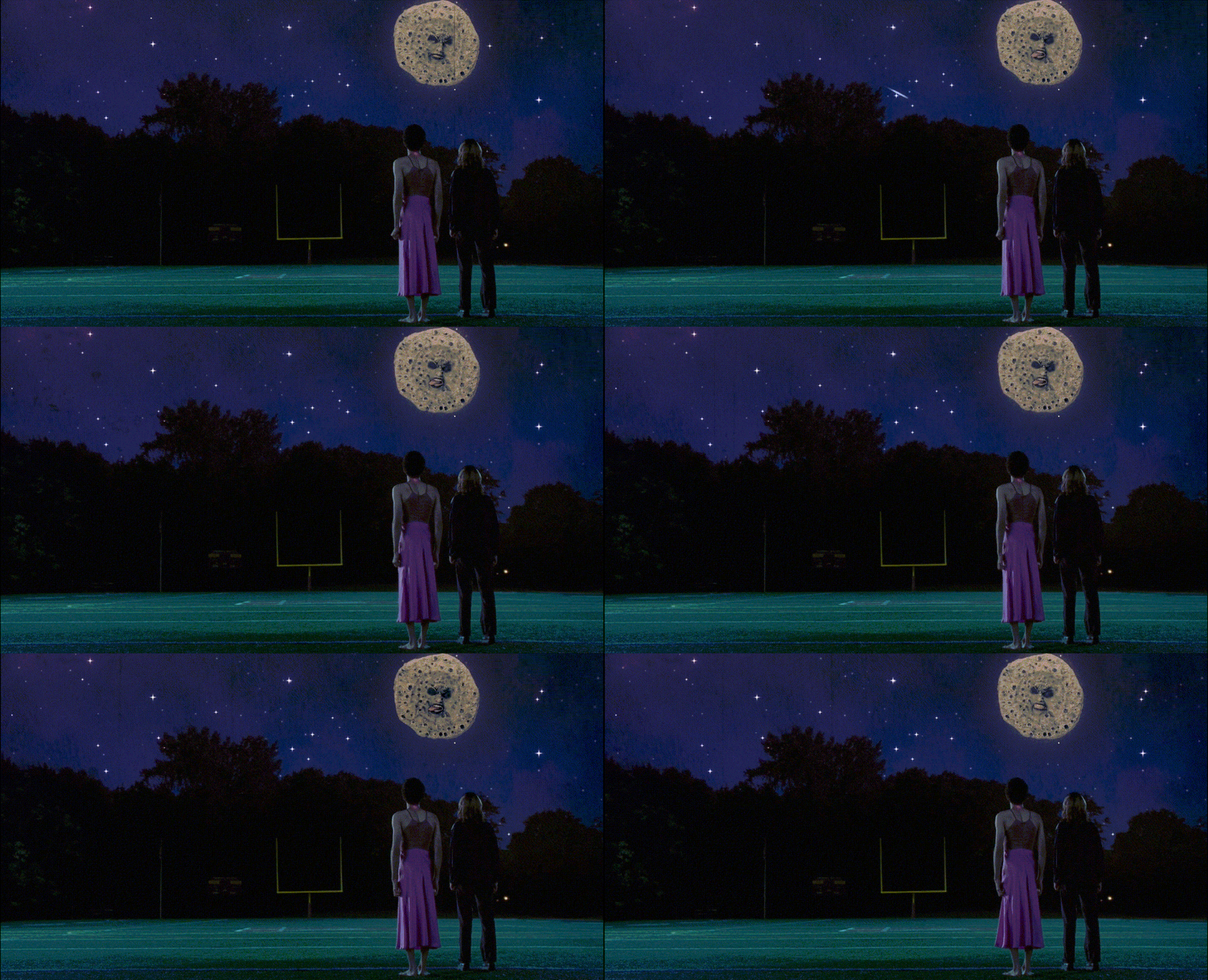
Owen doesn’t do it, but Maddy disappears again, this time for good. And Owen continues with his life. His dad dies and he takes over the mortgage. He gets married. He has kids. He follows his boss from the movie theater to a children’s entertainment center. He never loses his sense of encroaching monotonous dread.
I Saw the TV Glow borrows some of its most striking visual imagery from Videodrome, and is likewise an homage to Videodrome’s ambivalent perspective on the power of television. I Saw the TV Glow is widely interpreted as a trans allegory, that the scary and seemingly psychotic decision to commit suicide in hopes of waking up in your favorite television show is representing the scary and seemingly psychotic decision to transition in hopes of creating a better life for yourself. But what makes the film really work is that it doesn’t commit to this interpretation. It is just as possible to read the film as a representation of the dangers of staying trapped in a fantasy world rather than making the choice to create a life for yourself that’s worth living. I’ve seen both interpretations argued with passion, that either The Pink Opaque is the real world and Owen is trapped by his own inaction, or that Maddy is suffering from acute psychosis brought on by a television inflicted mind-virus. But what I think makes the film so good is that it doesn’t tell us either way—both are true. TV is a panacea. It’s good and powerful and soothing and reassuring. TV is a terror. It’s bad and isolating and meaningless and hides you away from the world. Both can be true.
I have been “out” as trans for about half of my life now, and the longer I’ve settled into being a transsexual, the less I feel connected to a real sense of identity with regard to it. I call myself a transsexual because it feels like a more accurately descriptive term than transgender. I have changed my sex via hormones and surgery. I’m not sure that I know or care very much about what my gender identity is. But we’ve been living in highly identity based times, where there is a sense that gender identity is something innate, that you discover within yourself, that’s always been there since birth. But I find this understanding of gender, and transness by extension, to be absolutely inane. I have nothing in common, insofar as how I experience life as a trans person, with someone who has a latent trans identity but has taken no steps—either social or physical—to transition.
There is something that feels, quite frankly, insane about choosing to transition. It reads to others as perverse and destabilizing and nearly impossible to understand, and there is something about transitioning that feels quite a lot like dying. Or like being buried alive. Or like realizing you’ve been buried alive for your whole life and you’re going to have to dig your starving and suffocating body through dirt that’s been packed too tight. To transition is take the risk that you will lose everyone you love and know—that your family will reject you, that your boss will fire you, that your friends will no longer recognize you—out of a desperate hope that when you do finally dig yourself out of that dirt, you’ll be happier, or at least living a life that is meaningful.
What I think is so brilliant about I Saw the TV Glow, is that it actually doesn’t matter either way. If The Pink Opaque is real, then you have to bury yourself alive in order to realize that life with meaning. But if it’s not, if Owen is right, that “this isn’t the Midnight Realm. It’s just the suburbs,” then you still have to bury yourself anyway. You have to decide to create a life that is worth living. You have to get a divorce or quit your job or move to a new country or do any of the things that people do in their lives that are scary and risky and proof that you do in fact have agency in your own life. You have to get on hormones. You have to change your name. You have to stop watching TV and fantasizing about the life you want but think you’re not allowed to have. You have to make that life for yourself.
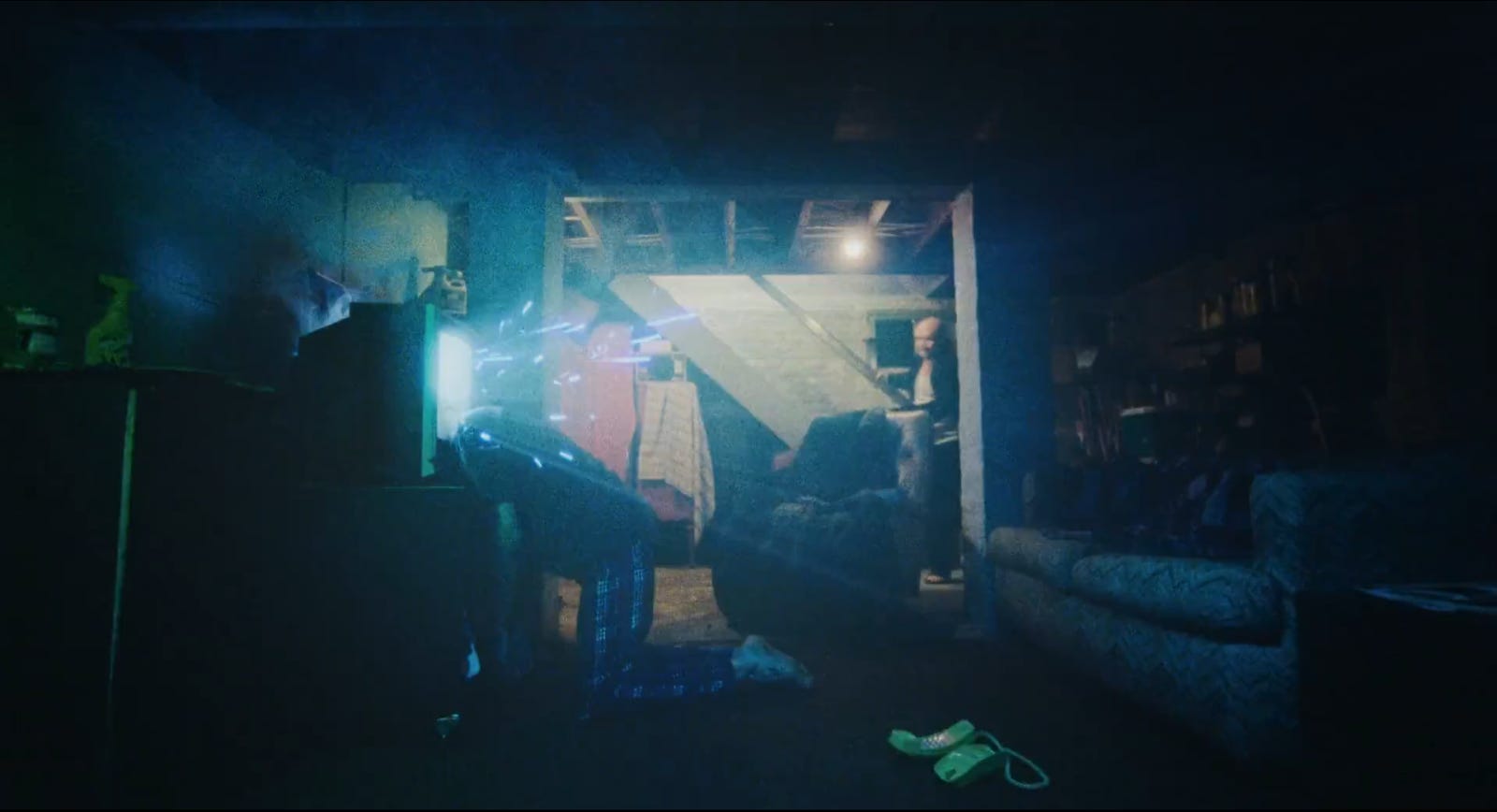
When Owen’s sense of reality slips during the final episode of The Pink Opaque, he makes a desperate attempt to return to his life as Isabel by breaking open the TV screen and putting his head through it. Owen’s dad finds him, electricity coursing through him, and pulls him out and brings him under running water, saving his life. This moment is beautiful and absolutely heartbreaking to me. Just minutes before, Owen speaks to his dad upon arriving home and his dad is framed in flickering and eerie light as if to look like he is Mr. Melancholy. But when Owen shrieks after being pulled out of the television, “this isn’t my home! You’re not my father,” the film feels more grounded than at any other moment throughout its runtime. Of course this is his home. Of course this is his father. His father who loves him and doesn’t understand him and doesn’t want him to die but doesn’t know how to let him live either. This isn’t the Midnight Realm. It’s just the suburbs. Isn’t that worse?
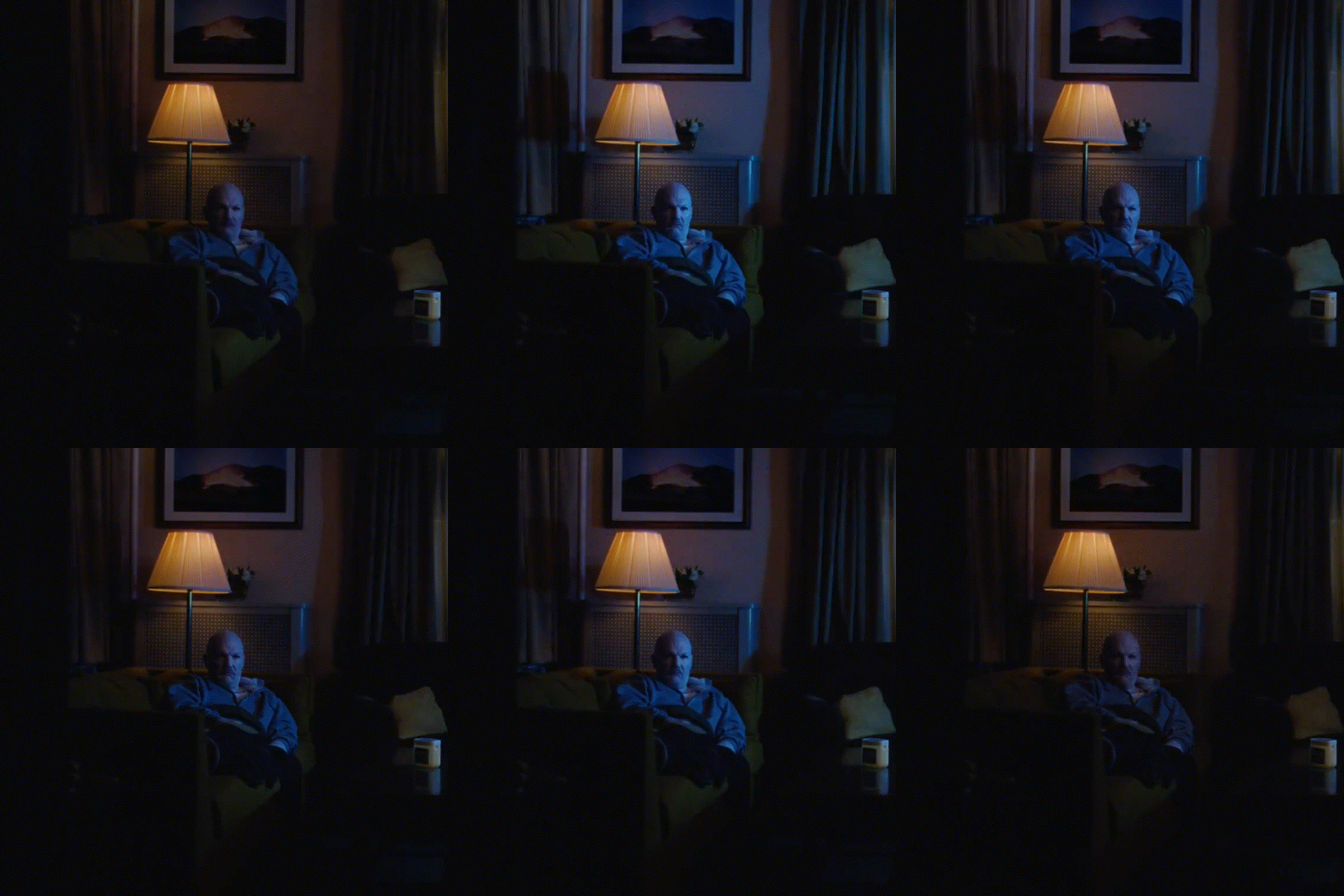
I think where Videodrome fails and I Saw the TV Glow succeeds is that Videodrome intends to have a primarily negative perspective towards television. But this is a difficult thing to accomplish—most films that try to portray a subject negatively end up making a fetish of their subject, by virtue of the medium. And in any case, how bad for us can visual media really be if we are watching a film ourselves? I Saw the TV Glow avoids this issue by not picking a stable position. Many people, trans people especially, take the stance that the film firmly makes the claim that yes, The Pink Opaque is the real world and that’s the only legible reading of it as a text. But I think you only have to go so far as to look at Schoenbrun’s first film, We’re All Going to the World’s Fair, about a teenager who loses her sense of reality while participating in an internet challenge, to see that Schoenbrun has a more complicated perspective on the role of visual media in personal identity development. I Saw the TV Glow holds many of the same anxieties that direct Videodrome, but it doesn’t fall into the trap of then fetishizing television by accident. It does that on purpose. It’s a love letter to Buffy the Vampire Slayer, to ‘90s sitcoms, to genre television, to TV as a medium and a physical object.
Many years later, Owen rewatches The Pink Opaque. He has a flat screen TV now and it’s available on a streaming service and he’s disturbed to find that the show is nothing like he remembers it. It looks much cheaper and cheesier and more childish and it isn’t scary at all. He’s embarrassed. This is the show that meant so much to him? That his only friend might have committed suicide for?
If Owen and Maddy had The Pink Opaque, and Jane Schoenbrun had Buffy the Vampire Slayer, then I, strangely enough, had Little Men, Louisa May Alcott’s saccharine 1871 sequel to Little Women, in which Jo March runs a school for boys. If Owen was Isabel, then I was Dan, a defiant and angry 14-year-old boy who Jo clearly favors above all her other students. From age 10, I reread that book over and over again, and spent a not insignificant amount of time fully dissociating, imagining myself to be a character in a book. In a different time. In a different place. In a body that felt less alien. Surrounded by people who loved me for who I was, not who I was supposed to be.
What’s interesting to me about having this kind of dissociative experience with texts like these is that while they are appealing as a fantasy, as a different life that where you can imagine being the person you are really supposed to be, the characters within them experience the same kind of dissatisfaction and alienation from their experience as any young person might—trans or not. “I don’t even have my learner’s permit yet. How can I have a destiny?” Isabel says to Tara in The Pink Opaque. In Buffy the Vampire Slayer, when Buffy’s mom finally learns that she is the slayer at the end of Season 2 and is reluctant to let her daughter go fight monsters, Buffy exclaims, “Do you think I chose to be like this? Do you have any idea how lonely it is? How dangerous? I would love to be upstairs watching TV, or gossiping about boys or—God, even studying! But I have to save the world. Again!” Dan, in Little Men, no matter how loved or accepted he is, is always angry and unsettled. “Every now and then I feel as if I must burst out somehow. I want to run straight ahead somewhere, to smash something, or pitch into somebody. Don’t know why, but I do, and that’s all about it,” he says to Jo.
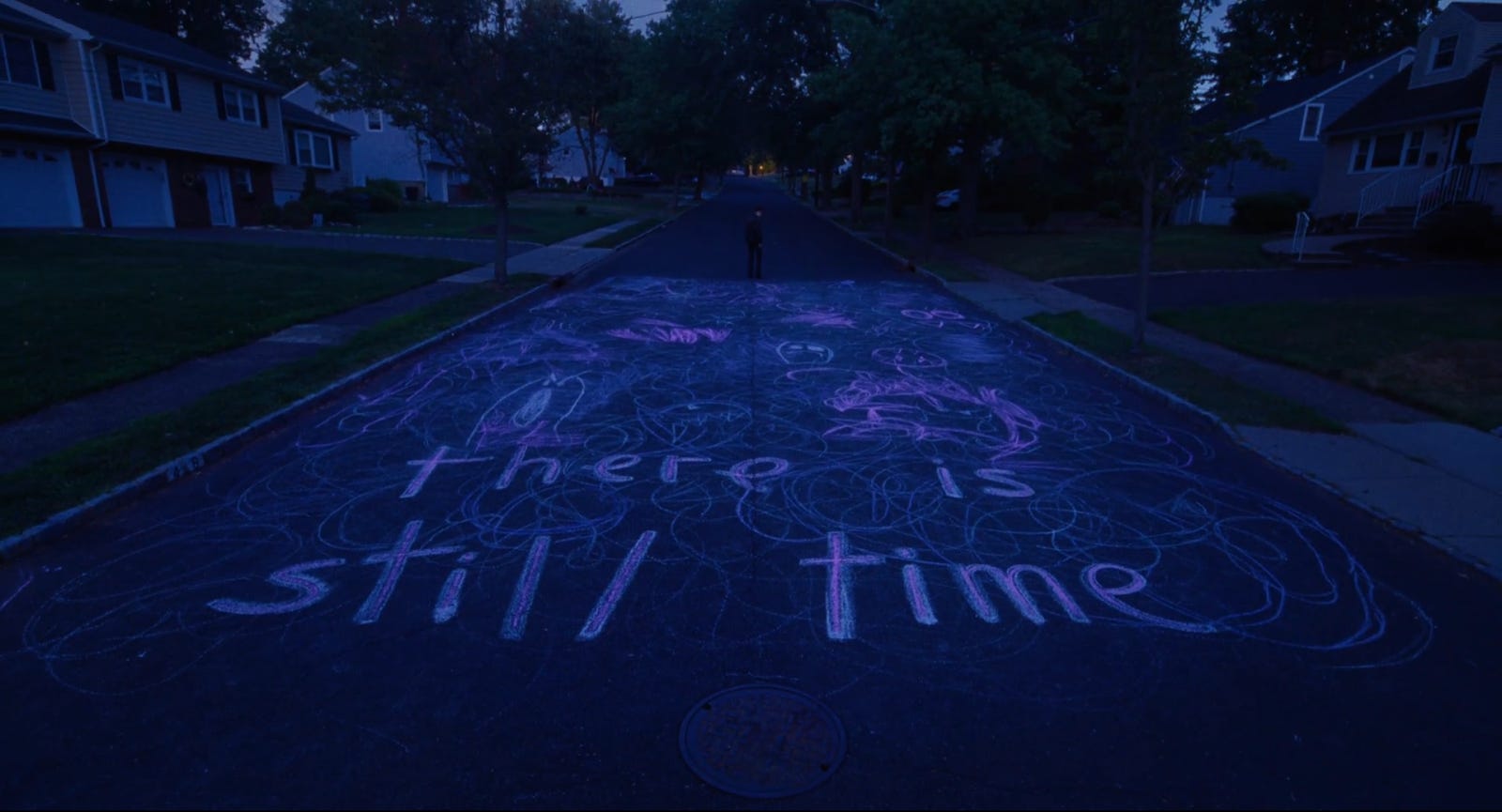
Owen never makes it back to his life as Isabel. There’s a hint that he might. We see, near the end of the film’s runtime, the words, “there is still time,” scrawled in sidewalk chalk on Owen’s street. And then he fantasizes that he does go through with it—he takes a box cutter and slices into his chest as if to check if his heart is there or if Mr. Melancholy still has it, and when his chest cavity opens, the glowing light of The Pink Opaque bursts out—but it’s just a fantasy.
But if he did make it, if he did awaken in his true form as Isabel, would that make any difference? Isabel has to fight monsters week after week. She’s never free from the threat of Mr. Melancholy. She is constantly crushed by her destiny. Does she want her life any more than Owen wants his?
The problem is that it doesn’t end. Transitioning was one of the most transformative experiences I’ve had in my life, but it was also a process I started almost 15 years ago. It has made me a happier and more thoughtful person, and one who I think is more open to dramatic life changes than most. But still, when I’m faced with a choice that requires more inertia than the alternative of just accepting life as it is, I realize that I haven’t reached the finish line yet. I still don’t have the life I want. I have to pursue that every day. And that’s the really terrifying and exhilarating thing I’ve discovered—that life is about the pursuit, not the result. If you dig yourself out of a hole, you’re only going to discover another hole to dig yourself out of. This is not a futile process. This is how you create a life of meaning. By realizing that you’ve been buried alive and making the choice that you don’t want to be buried anymore. It’s about the feeling that comes with pulling yourself out of the dirt, not whatever it is that you’re going to find on the other side. You might like it, you might not, but that experience of choosing will change you in a way nothing else will. Don’t die wondering. There is still time. So get digging. Five stars.
Not LBGT myself, yet this movie hit me like no other. The existential dread of time moving faster and faster as you deny your own true calling is something that has haunted me over the decades. No other media has presented that idea so accurately to my experience. Thankfully I’ve tried hard most of my adult life to fight for who I am, and what I need to do.